SAHAR ZUHER
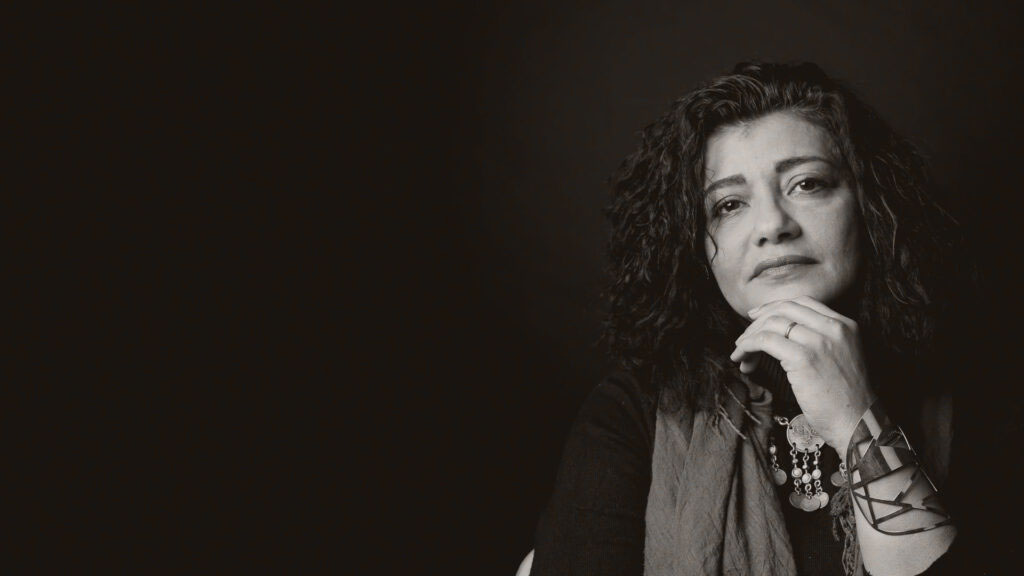
Sahar Zuher (b. Baghdad, Iraq) is a multidisciplinary artist based in Kapellen, Antwerp. Working across painting, printmaking, drawing, collage, sculpture, and video, she incorporates materials such as rusted metal, cardboard, scrap fabric, antique paper, ink, and wood to explore memory, identity, displacement, and survival. Her childhood, shaped by war and forced migration, profoundly informs her work, which transforms worn garments, fragmented scripts, and makeshift shelters into visual languages of resilience.
Arabic calligraphy, particularly geometric Kufic script, recurs throughout her oeuvre as both a personal reflection and a vessel for collective cultural memory. Zuher is best known for Once Upon a Time, an installation narrating the story of a fighter who carried his lover’s letters through war—fragile yet enduring symbols of connection stronger than violence. This work, which employs six printmaking techniques layered on Lokta paper treated with ink and coffee, marked a milestone in her practice as her first sculptural work presented to a professional audience and was awarded first prize by the Royal Academy of Fine Arts Antwerp, leading to a solo exhibition.
Among her other important series, Monoprint on Postcard (2002–2004) reflects on family correspondence during the fall of Iraq’s regime, using symbolically encoded monotype prints to explore the fading intimacy of handwritten letters. Fragile (2016) examines the social consequences of war, particularly its impact on children, transforming photographs and media images into works depicting hunger, illness, loss, and displacement. Recent works expand into stop motion, animation, and installation, addressing migration, the history of Iraq, the lives of working children, and cross-cultural connections inspired by Dante’s Divine Comedy and Islamic concepts.
Technique and Style
Her technique merges traditional printmaking methods—monotype, drypoint, linocut, lithography, and screen printing—with contemporary mixed-media processes. She layers, erases, and re-inscribes elements, stains paper with coffee and ink to evoke age and memory, and incorporates textiles or garments to embed traces of lived experience. Zuher’s style is defined by layered surfaces, textured materiality, and the interplay between abstraction and symbolism.